

Monthly giving is now a standard fundraising option.
Donors want flexible ways to support your mission. Nonprofits need predictable revenue. A recurring gift connects both needs.
Recent M+R Benchmarks data shows that monthly giving represented 27% of online nonprofit revenue in 2025. The same report found that 71% of monthly donors were still active after 12 months.
The opportunity is clear.
The preparation must be clear too.
Use this checklist before launching a monthly donor campaign.
1. Set the program target first
Define the operating goal before writing the appeal.
Track:
- New monthly donors
- Monthly recurring revenue
- Average monthly gift
- Donor retention
- Monthly donor cancellations
- Failed payment recovery
- Upgrade rate
Start with a measurable target.
Example:
Enroll 100 new monthly donors at an average of $15 per month by December 31.
That target creates a direct calculation:
- 100 donors
- $15 per month
- $1,500 in new monthly revenue
- $18,000 in projected annual revenue before attrition
Add a retention target. Add a payment recovery target. Add a deadline.
Do not launch with “increase monthly giving” as the only objective.
2. Select the right prospects
Monthly giving is not only an acquisition strategy. It is a donor engagement strategy for people who already show commitment.
Start with existing supporters.
Prioritize:
- Donors who have given more than once
- Donors who have given for multiple years
- Event participants
- Volunteers
- Email subscribers with high engagement
- Peer-to-peer fundraisers
- Recent first-time donors who responded positively
- Supporters who give smaller gifts several times per year
Use your CRM to create a prospect segment.
Do not send the same message to every contact. A repeat donor may be ready for a monthly invitation. A new subscriber may need more mission information first.
Segment before you ask.
3. Use practical monthly amounts
A monthly donor does not need to make a large commitment.
Recommended starting options:
- $10 per month
- $15 per month
- $25 per month
These amounts create an accessible entry point while giving donors a clear choice.
Recent sector benchmarks place the average online monthly gift in the approximate $24–$30 range. Your organization’s average may differ by mission, audience, geography, and donor acquisition channel.
Use your own data where available.
Test:
- Three suggested monthly amounts
- A custom amount field
- Monthly versus one-time gift selection
- Impact language beside each amount
- A higher anchor amount for donors with greater capacity
Keep the options limited. Too many choices slow down the decision.
4. Connect each amount to an outcome
“Give monthly” is not a complete message.
State what recurring support makes possible.
Use specific, accurate examples:
- $10 per month helps provide transportation assistance
- $15 per month supports ongoing education materials
- $25 per month helps fund regular meals or direct services
Only use impact statements your organization can verify.
Do not promise that one gift pays for an entire program unless that is accurate. Avoid vague statements such as “every dollar changes everything.”
Use simple value framing:
- $10 per month = $120 per year
- $15 per month = $180 per year
- $25 per month = $300 per year
Then explain how consistent revenue supports planning, staffing, services, or resources.
Monthly donors need a clear reason to continue.
5. Make recurring giving easy to select
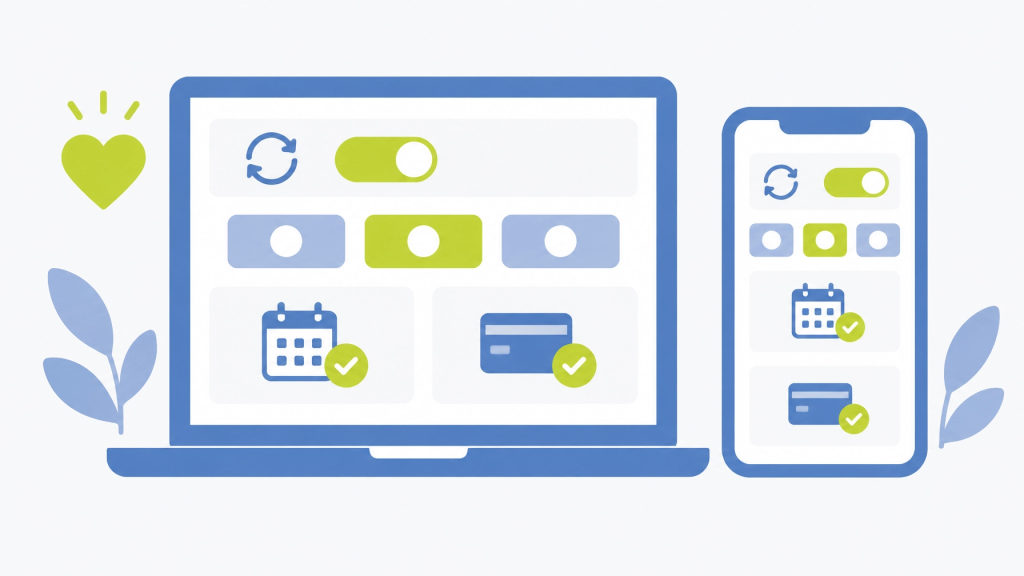
Place the monthly option where donors can see it.
Your donation page should include:
- A clear one-time or monthly selection
- Suggested monthly gift amounts
- Mobile-friendly design
- Minimal required fields
- Secure payment processing
- Multiple payment methods where available
- A confirmation page
- Immediate email receipts
- A simple way to update payment information
Do not hide monthly giving behind a secondary page or small link.
Review your nonprofit website fundraising checklist. Check the donation call to action, user experience, conversion path, credibility elements, and mission clarity.
Run the complete process on a phone before promoting the campaign.
Test:
- Gift selection
- Payment submission
- Receipt delivery
- CRM record creation
- Recurring gift schedule
- Cancellation and update process
A broken form is a failed campaign.
6. Prepare the welcome sequence before launch
Retention starts immediately after enrollment.
Create a short onboarding sequence:
Message 1 : Immediate confirmation
Confirm:
- Gift amount
- Billing frequency
- First payment
- Receipt information
- How to update payment details
Message 2 : Within one week
Show what monthly support makes possible.
Use one program update, service result, or verified impact example.
Message 3 : Within 30 days
Recognize the donor as a monthly supporter. Explain what they can expect from future communications.
Avoid asking for another donation during onboarding.
The first objective is confirmation and trust. The second is connection. The third is continued engagement.

7. Build a retention plan
Monthly giving is not set-and-forget revenue.
Create a recurring donor communication calendar.
Include:
- Regular impact updates
- Donor anniversaries
- Program milestones
- Thank-you messages
- Annual giving summaries
- Occasional behind-the-scenes content
- Payment update reminders
- Monthly donor surveys
Do not send only payment receipts.
A recurring donor should understand the ongoing effect of their support. Use photos, data, short stories, videos, and program updates when appropriate.
Measure retention by month.
According to M+R’s 2026 Benchmarks report, 81% of sustainers remained active after seven months and 71% remained active after one year.
Use these figures as reference points, not guarantees.
8. Create an upgrade path
Existing monthly donors may be ready to increase their support.
Make the next action simple.
Possible upgrade paths:
- $10 to $15 per month
- $15 to $20 per month
- $20 to $25 per month
- A one-time year-end gift in addition to the monthly gift
- An annual increase invitation
- A program-specific upgrade campaign
Ask for a modest increase.
Use language such as:
Increase your monthly gift by $5.
Explain the annual difference:
- An extra $5 per month = $60 per year
- An extra $10 per month = $120 per year
Invite. Do not pressure.
Send upgrade requests only after the donor has received adequate stewardship. Avoid asking immediately after enrollment or during a payment problem.
9. Treat monthly donors differently during year-end campaigns
Year-end remains a major fundraising period. M+R reports that nonprofits received 37% of annual online revenue in December 2025, with 4% arriving on December 31.
Monthly donors should be included in year-end plans.
They should not receive the same message as a non-donor.
Use a separate year-end segment.
Recommended sequence:
- Thank monthly donors for their ongoing support
- Share a year-end impact summary
- Confirm what their recurring gifts helped sustain
- Invite an optional additional gift or monthly upgrade
- Provide a clear deadline when relevant
Frame the year-end ask as an opportunity to extend impact.
Do not imply that the donor’s existing monthly gift is insufficient.
Protect the relationship first.
10. Track the full donor journey
Monthly giving performance requires more than counting new enrollments.
Review the complete journey:
- Where did the donor first see the offer?
- Which email or ad produced the conversion?
- What monthly amount did the donor select?
- Did the first payment process?
- Did the donor open the welcome messages?
- Did the donor remain active after 3, 6, and 12 months?
- Did the donor upgrade?
- Did a payment fail?
- Was the payment recovered?
- Did the donor make an additional year-end gift?
Use this information to improve future nonprofit fundraising campaigns.
Track performance by channel:
- Website
- Organic social media
- Paid Meta advertising
- Google Ad Grant traffic
- Events
- Direct mail
- Peer-to-peer fundraising
A monthly giving program is a connected system. The donation page, campaign message, CRM, payment platform, email automation, and stewardship plan must work together.
Monthly giving campaign checklist
Before launch:
- Define the enrollment target
- Set $10, $15, and $25 monthly options
- Confirm accurate impact statements
- Segment existing supporters
- Optimize the donation page
- Test mobile giving
- Confirm payment and CRM workflows
- Write the welcome sequence
- Create a retention calendar
- Build the upgrade path
- Prepare a separate year-end message
- Set reporting dates
Monthly giving is a practical way to build more predictable revenue and stronger donor relationships.
Prepare the system before making the ask.
Start with the donor experience. Build the recurring program. Track the results.
